Symbolic Stars (神煞) in BaZi: What They Add
Symbolic stars are fixed lookup tables that attach a named star to a chart when particular stem and branch combinations occur. They are annotation on top of the structural reading. The element balance, ten gods and palaces carry the weight, and the stars add texture.
How do the lookup tables attach a star?
Each star has a key and a table. The key is a stem, a branch or an element taken from the chart. The table returns one or more branches. If any pillar's branch matches, the star is attached to that pillar. The pillar then decides the life area and era the star colours, as the four palaces describe.
The sample is 王大明, a fictional man born 1988-03-15 at 09:30 in Singapore. His pillars are 戊辰 (Earth Dragon) 乙卯 (Wood Rabbit) 己巳 (Earth Snake) 戊辰 and his Day Master is 己 (yin Earth). The engine checks the stem-keyed nobles from both the day stem and the year stem. It checks the branch-keyed stars from both the year branch and the day branch.
Key facts
- A star is a pure lookup: a key from the chart goes into a fixed table, and a matching branch attaches the star to that pillar.
- For Day Master 己, the 文昌 (study star) branch is 酉 (Rooster, ), the 學堂 (study hall) branch is 寅 (Tiger, Wood), and the 天乙貴人 (nobleman star) branches are 子 (Rat, Water) and 申 (Monkey, ).
- The sample chart carries three stars: 太極貴人 (year and hour), 華蓋 (year and hour) and 劫煞 (day).
- The sample has no 天乙貴人, 文昌貴人 (study star), 學堂, 桃花 (romance star), 驛馬 (travel horse), 祿神 (salary star) or 空亡 (void).
- The sample's void branches are 戌 (Dog, Earth) and 亥 (Pig, Water), taken from the day pillar 己巳, and none of his branches falls there.
- In the engine's learning score, a 華蓋 adds +10 points of a 70-point result, so a star nudges the score and never decides it.
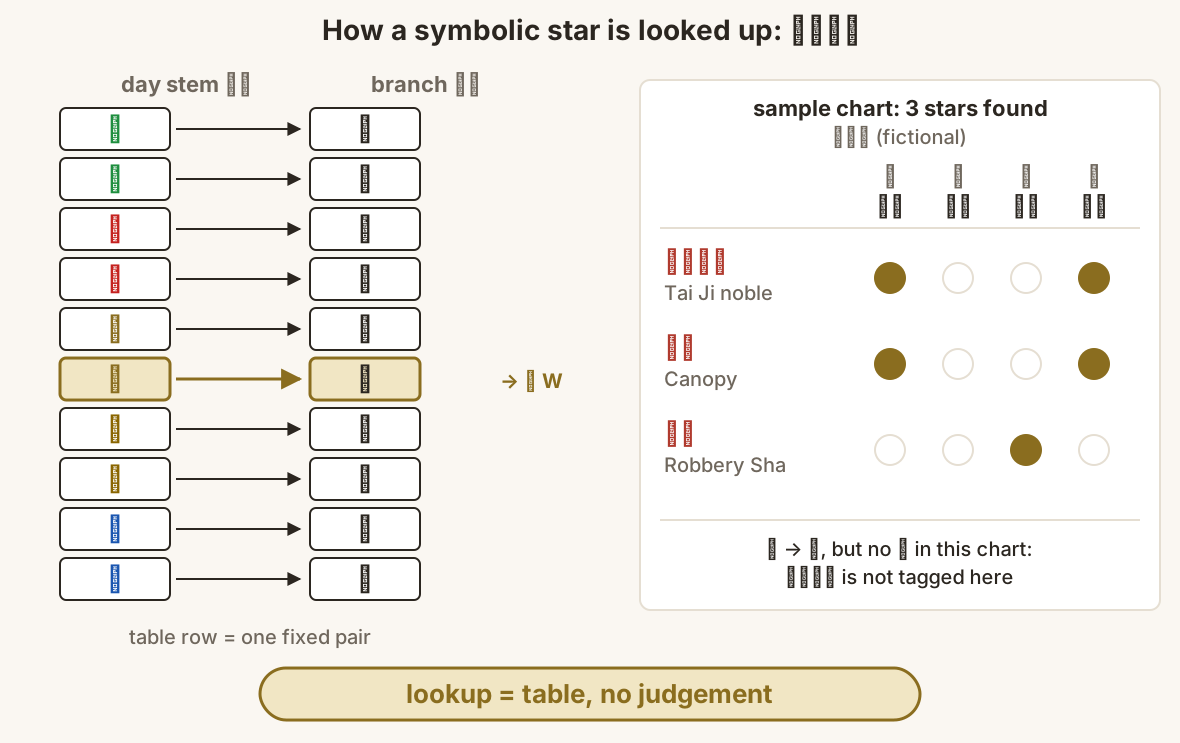
Table 1: where each star is looked up
| Star | Key | Table result for the sample | Meaning (engine wording) |
|---|---|---|---|
| 天乙貴人 | day stem, year stem | 己: 子 or 申; 戊 (yang Earth): 丑 (Ox, Earth) or 未 (Goat, Earth) | helpful people appear at critical moments |
| 太極貴人 | day stem, year stem | 己 and 戊: 辰 (Dragon, Earth), 戌, 丑, 未 | affinity for philosophy, metaphysics, deep research |
| 文昌貴人 | day stem, year stem | 己: 酉; 戊: 申 | study, writing, examinations |
| 學堂 | Day Master element | Earth: 寅 | natural learner, academic aptitude |
| 祿神 | day stem | 己: 午 (Horse, Fire) | innate earning capacity |
| 羊刃 (goat blade) | day stem | 己 has no entry | drive and decisiveness |
| 天德 (heavenly virtue) 貴人 (helpful people) | month branch | 卯 (Rabbit, Wood): 申 | protective benevolence, eases crises |
| 月德 (monthly virtue) 貴人 | month branch | 卯: 甲 (yang Wood) | quiet protection and goodwill |
| 空亡 | day pillar's ten-day group | 己巳: 戌, 亥 | the tagged pillar's matters feel intangible until triggered |
The engine's 學堂 table by element is Wood 亥, Fire 寅, Earth 寅, 巳 (Snake, Fire) and Water 申. Earth borrows Fire's position, which is the table's convention (method note).
See these rules applied to your own chart: free BaZi reading →
Which stars are worth knowing?
Five stars come from the year or day branch group. Table 2 gives the fixed result for each of the four groups.
Table 2: branch-group stars
| Group | 桃花 | 驛馬 | 華蓋 | 將星 (general star) | 劫煞 |
|---|---|---|---|---|---|
| 申·子·辰 | 酉 | 寅 | 辰 | 子 | 巳 |
| 寅·午·戌 | 卯 | 申 | 戌 | 午 | 亥 |
| 巳·酉·丑 | 午 | 亥 | 丑 | 酉 | 寅 |
| 亥·卯·未 | 子 | 巳 | 未 | 卯 | 申 |
The sample's year branch 辰 belongs to the 申·子·辰 group. That group's 華蓋 is 辰, which sits in his year and hour pillars. Its 劫煞 is 巳, which is his day branch. Its 桃花 is 酉, 驛馬 is 寅 and 將星 is 子, and none of those appears in his four branches. His day branch 巳 belongs to the 巳·酉·丑 group, whose stars are 午, 亥, 丑, 酉 and 寅. None of them appears either.
In plain terms, the engine gives these readings:
- 天乙貴人 Nobleman. The most valued star. Help arrives through people at critical moments.
- 文昌貴人 Scholar star. Study, writing and examinations. Its direction gives the study corner.
- 華蓋 Canopy. Solitary depth, spirituality and the arts. The engine adds that it thrives on niche study.
- 將星 General star. Leadership and command presence.
- 桃花 Peach Blossom. Charm, attraction and social magnetism, mostly read through the years that trigger it.
- 劫煞 Robbery Sha. Guard resources and avoid overexposure to risk. It is a note, not a threat.
- 空亡 Void. The tagged pillar's matters feel intangible until triggered.
What does the sample chart show?
The engine finds three stars. 太極貴人 sits in the year and hour pillars, which reads as an affinity for philosophy, metaphysics and deep research. 華蓋 sits in the same two pillars, which reads as solitary depth and spirituality. 劫煞 sits in the day pillar, which reads as guard resources.
The absences matter as much as the hits. No 天乙貴人 is present. 己 needs 子 or 申 and 戊 needs 丑 or 未, but the chart's branches are 辰, 卯, 巳 and 辰. The engine does not invent a helper star to fill the gap. No 空亡 is present either, since 戌 and 亥 are missing from the chart.
The stars also feed the engine's domain scores. The learning structure scores 70 (prominent), built from resource (印) present at +10, 華蓋 at +10 and the rest from the structure. The score is assembled from auditable parts, and the stars are a minority of them. The engine labels these scores a modern synthesis, not a classical rule (method note).
See these rules applied to your own chart: free BaZi reading →
How much weight should the stars get?
Less than the structure, every time. A Nobleman does not rescue a chart whose useful element is buried, and a Void does not sink one whose structure is sound. The honest use of symbolic stars is descriptive precision. They give a name to textures people recognise in themselves, such as the student who tests as brilliant but studies alone.
When a star and the structure agree, say it once with confidence. When they disagree, the structure wins. That ordering is how the engine builds every reading it computes. The sample's structure is a weak Day Master with Fire (火) and Earth (土) as favourable elements, and the three stars only colour it.
What changes for Singapore and Malaysia readers?
Stars depend on the year pillar, the day pillar and the month branch, so the local calendar rules matter.
- Year boundary. The year stem and year branch change at Start of Spring (立春), which falls on 2027-02-04 for the 2027 year. A birth in late January or early February may carry the previous year's stem. That gives a different set of nobles and a different branch group.
- Time zone. Singapore ran on UTC+7:30 before 1982-01-01 and UTC+8 after it. Malaysia has used UTC+8 since 1982-01-01. A wrong offset can change the hour pillar, and the hour pillar is one of the four places a star can land.
- Month branch. 天德 and 月德 key off the month branch, which turns at the solar terms and not on the calendar month.
- Homes. The 文昌 star is the one with a direct use in an HDB flat or condominium unit. It tells you which corner of the unit suits a desk. See the study corner guide.
FAQ
What are symbolic stars in BaZi?
Symbolic stars are fixed lookup tables that attach a named star to a chart when particular stem and branch combinations occur. They are annotation on top of the structural reading. The element balance, ten gods and palaces carry the weight.
How is a symbolic star attached to my chart?
Each star has a key and a table. The key is a stem, a branch or an element from the chart. The table returns one or more branches. If any pillar's branch matches, the star is attached to that pillar.
Does a 天乙貴人 Nobleman star rescue a weak chart?
No. A Nobleman does not rescue a chart whose useful element is buried, and a Void does not sink one whose structure is sound. When a star and the structure disagree, the structure wins. Stars only give texture.
What if my chart has no 桃花 or 天乙貴人 star?
The engine does not invent a star to fill the gap. The sample chart has no 天乙貴人 because its branches are 辰, 卯, 巳 and 辰. Absences matter as much as hits, and they do not mean anything is wrong.
Why does my year of birth matter for stars in Singapore or Malaysia?
Stars depend on the year pillar, the day pillar and the month branch. The year stem and branch change at Start of Spring, not 1 January. A late January or early February birth may carry the previous year's stem. A wrong time zone offset can also change the hour pillar.
Sources and method
- Star tables: the classical lookup tables for Tianyi (天乙), Taiji (太極), 文昌, 學堂, 祿神, 羊刃, 天德, 月德 and the branch-group stars, as coded in the engine.
- Checking rule: nobles checked from both the day stem and the year stem; branch-group stars checked from both the year and day branches (method note).
- Void branches: 空亡 taken from the day pillar's ten-day group.
- Meanings: the engine's own wording for each star (method note).
- Weighting: structure first, stars as annotation, which is the engine's ordering (method note).
- Stem and branch relations: 三命通會 (Ming-era BaZi classic), in the chapters the engine cites.
Find which stars your own chart carries in the free reading at /start, and see how their timing plays out in luck cycles and windows.
Every line of a bazifor.me reading cites the classical rule that produced it. Deterministic engine, no account needed, workspace stays private.
Get your free reading →