
Get a scored Chinese name for your baby, built from the baby's own chart.
You need the surname character, sex, and the birth or due date and time.
You get useful elements, five grids, a ranked shortlist and a printable name card.

Step 1 · The baby
Five details give the chart. Only the date is required.

Questions about the name builder
How names are scored, how Singapore and Malaysia names are handled, and where the method stops.
How is a name scored?
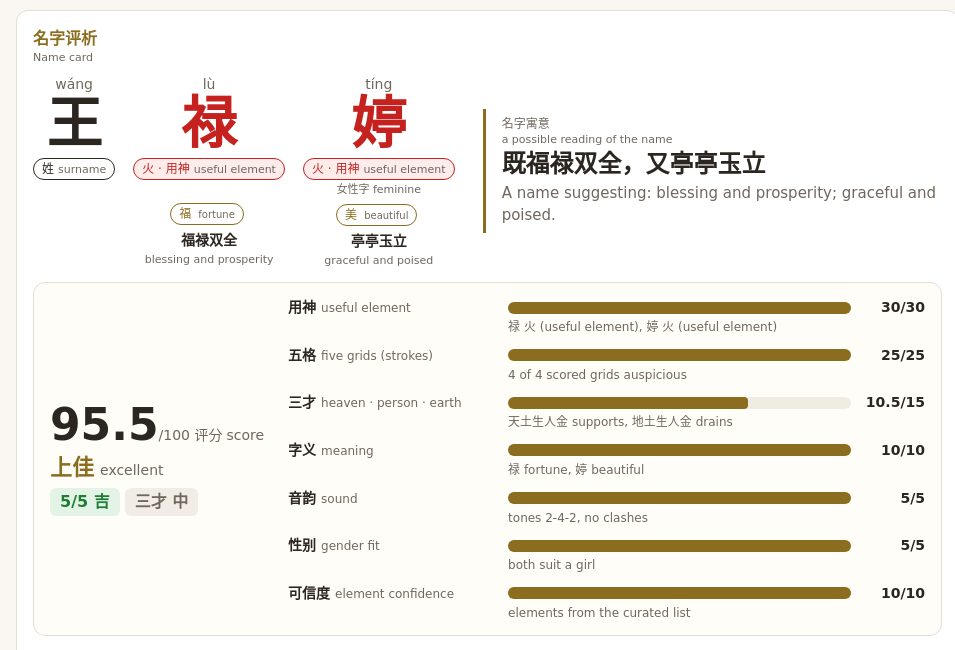
Every name is scored out of 100 in five parts: useful god 37.5, Five Grids (五格) 31.25, Three Talents (三才) 18.75, sound (音韵) 6.25 and gender fit (性别) 6.25. Useful god asks whether each character carries an element the baby's chart needs: Wood, Fire, Earth, or Water. The Five Grids are five stroke-count grids. Three Talents asks whether the elements of the heaven, person and earth grids support each other. Sound covers tones, repeated sounds and unlucky homophones. Gender fit asks whether the characters suit a boy or a girl.
Two more figures sit beside the score and do not add to it: character meaning (字义), out of 10, which sorts what the characters mean into 16 categories, and confidence (可信度), out of 10, which shows how far the engine can trust the element data behind each character.
What do the grades mean?
The total maps to a grade: excellent (上佳) at 90 and above, good (佳) at 80 and above, fair (可) at 65 and above, and needs a second look (待斟酌) below 65. A strong sound hit caps the grade at needs a second look, whatever the total.
What does the sound check look at?
Sound is checked by simple house rules: the tone pattern, repeated sounds, and Mandarin sound-alikes (Chinese words the name sounds like), in three strengths (same syllables and tones, same syllables with different tones, merged consonants). Severe words such as "death" (死亡) cap the grade whatever the tones. The word list was hand-reviewed from CC-CEDICT (CC BY-SA 4.0). The check also looks for English words the pinyin spelling reads as, since many Singapore and Malaysia children are addressed in English at school and at work.
What do I get besides the score?
You get the Five Grids with their auspicious (吉) or adverse (凶) verdicts, the element of every character, its Kangxi (康熙) stroke count, a short reading of what the name suggests, and a shortlist of up to eight names to compare.
I only know our surname as Tan, Lim, Lee, Ng or Wong. What do I enter?
Enter the Chinese character, for example 王, 林, 李 or 吴. Tan, Lim, Lee, Ng and Wong are Hokkien, Teochew or Cantonese spellings of a character, not different surnames, and the scoring needs the character itself. The builder uses it for the stroke count and the grids, so pick the one your family writes.
How are strokes counted, and which time does the chart use?
The Five Grids use the Kangxi stroke count from the Kangxi dictionary, which counts the traditional form of each character. The traditional 祿 has more strokes than the simplified 禄, so the builder counts the traditional form and shows you the strokes it used. The chart is calculated in true solar time for the birth city (Singapore unless you pick another). A due date gives a provisional chart that you can recalculate after birth. Read how Chinese baby names are scored for the full method.
What does a result look like?
Fictional example, computed by the engine. A fictional baby girl born 2026-03-15 09:30 Singapore time, surname 王. The three names below are real engine output for that chart; each scores good or better.
| Name | Elements | Kangxi strokes | Meaning | Score | Grade |
|---|---|---|---|---|---|
| 王熙乐 (example name) | 熙 Fire, 乐 Fire | 王 4, 熙 14, 乐 15 | bright and harmonious; happy and content | 97.5 / 100 | excellent |
| 王暖璇 (example name) | 暖 Fire, 璇 Fire | 王 4, 暖 13, 璇 16 | warm-hearted; fine jade, a guiding star | 96.5 / 100 | excellent |
| 王晨光 (example name) | 晨 Fire, 光 Fire | 王 4, 晨 11, 光 6 | the hope of dawn; bright and open | 96.0 / 100 | excellent |
How far can I trust the result?
This tool is a first screen, not a verdict. It ranks names by the BaZi (八字) useful god elements, the Five Grids and Three Talents stroke methods, and a partly curated character list. The Five Grids are a modern school, not a classical rule, and element assignments and stroke counts differ between dictionaries and practitioners. Sound is checked by simple house rules and does not judge dialect readings, the zodiac animal or family naming rules. Meaning is screened only for clearly adverse characters. Treat the ranking as a shortlist for the family (and a practitioner) to review, not a verdict.