How to Read a Four Pillars Chart: Stems, Branches, Hidden Stems and the Four Palaces
A BaZi chart (四柱八字) is a grid of eight characters. Each of the year, month, day and hour of birth gets a heavenly stem (天干) and an earthly branch (地支). The stem of the day pillar is the Day Master (日主), and every other character in the chart is read in relation to it.
What is in each of the four pillars?
Each pillar is a pair of characters. The stem sits on top and the branch sits underneath. The ten stems are 甲 (yang Wood) 乙 (yin Wood) 丙 (yang Fire) 丁 (yin Fire) 戊 (yang Earth) 己 (yin Earth) 庚 () 辛 () 壬 (yang Water) 癸 (yin Water). The twelve branches are 子 (Rat, Water) 丑 (Ox, Earth) 寅 (Tiger, Wood) 卯 (Rabbit, Wood) 辰 (Dragon, Earth) 巳 (Snake, Fire) 午 (Horse, Fire) 未 (Goat, Earth) 申 (Monkey, ) 酉 (Rooster, ) 戌 (Dog, Earth) 亥 (Pig, Water). Every stem and every branch belongs to one of the five elements, and each is yin or yang.
The sample person here is 王大明, a fictional man born on 1988-03-15 at 09:30 in Singapore. His pillars are 戊辰 (Earth Dragon) (year), 乙卯 (Wood Rabbit) (month), 己巳 (Earth Snake) (day) and 戊辰 (hour). His Day Master is 己, yin Earth. Everything below uses this one chart, so you can follow each step without switching examples.
The stem is the visible, declared part of a pillar. The branch is its foundation. A branch also hides one to three further stems inside it, which the next section covers. The year branch carries the zodiac animal most people know their birth year by.
Key facts
- A chart has 4 pillars and 8 characters, and each pillar is one stem plus one branch.
- The sample chart is 戊辰 乙卯 己巳 戊辰, with Day Master 己 (yin Earth).
- The four palaces cover ages 0-15 (year), 16-32 (month), 33-48 (day) and 49+ (hour).
- Branch 辰 hides 戊, 乙 and 癸, branch 卯 hides 乙, and branch 巳 hides 丙, 庚 and 戊.
- The engine rates the Day Master weak Day Master (身弱), with a score of -0.97 and roots in 辰, 巳 and 辰.
- The clock time 09:30 becomes true solar time 08:16 before the pillars are cast.
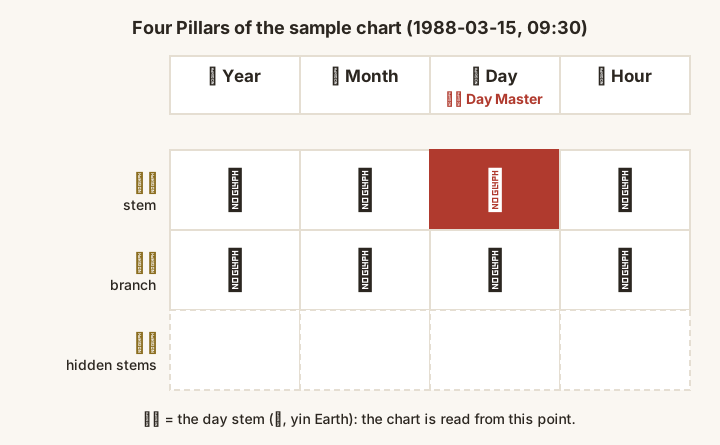
Table 1: the sample chart, pillar by pillar
| Pillar | Stem | Branch | Branch element | Hidden stems | Stem god |
|---|---|---|---|---|---|
| Year Pillar (年柱) | 戊 | 辰 | Earth (土) | 戊, 乙, 癸 | Rob Wealth (劫財) |
| Month Pillar (月柱) | 乙 | 卯 | Wood (木) | 乙 | Seven Killings (七殺) |
| Day Pillar (日柱) | 己 | 巳 | Fire (火) | 丙, 庚, 戊 | Day Master |
| Hour Pillar (時柱) | 戊 | 辰 | Earth | 戊, 乙, 癸 | Rob Wealth |
The stem god column shows each stem's relation to the Day Master. Those relations are the ten gods. The Day Master itself is the reference point, so it carries no god.
See these rules applied to your own chart: free BaZi reading →
What are hidden stems, and why do they matter?
Hidden stems (藏干) are the extra stems stored inside a branch. A chart that looks thin in one element on the surface may carry it below. This is why any serious element count includes them. The engine lists the hidden stems for all twelve branches in Table 2.
Table 2: hidden stems in the twelve branches
| Branch | Element | Hidden stems |
|---|---|---|
| 子 | Water (水) | 癸 |
| 丑 | Earth | 己, 癸, 辛 |
| 寅 | Wood | 甲, 丙, 戊 |
| 卯 | Wood | 乙 |
| 辰 | Earth | 戊, 乙, 癸 |
| 巳 | Fire | 丙, 庚, 戊 |
| 午 | Fire | 丁, 己 |
| 未 | Earth | 己, 丁, 乙 |
| 申 | 庚, 壬, 戊 | |
| 酉 | 辛 | |
| 戌 | Earth | 戊, 辛, 丁 |
| 亥 | Water | 壬, 甲 |
In the sample, the Day Master 己 is Earth. Its branches 辰, 巳 and 辰 each hide the Earth stem 戊, so the engine records a root (rooting, 通根) in all three. A Day Master with no visible peers can still be rooted this way.
The engine weights every visible stem and every hidden stem. Its element totals add up to 10.0: Wood 2.67, Fire 1.0, Earth 5.33, 0.33 and Water 0.67. Earth is 53.3 % of the chart, and is only 3.3 %. The weights come from a fixed rule, so two honest tools should return the same figures.
How do the four pillars become four palaces?
Classical doctrine reads the same four columns a second way, as the four palaces (宮位). The palace tells you which area of life a character colours and roughly which stage of life it speaks to. Table 3 gives the ages and the sample's reading.
Table 3: the four palaces in the sample chart
| Palace | Ages | Governs | Sample reading |
|---|---|---|---|
| Year | 0-15 | ancestry, childhood, first impressions | stem god Rob Wealth, hides Rob Wealth, Seven Killings, Indirect Wealth (偏財) |
| Month | 16-32 | parents, early adulthood, career headquarters | stem god Seven Killings, hides Seven Killings |
| Day | 33-48 | the self (stem), spouse and home (branch) | branch 巳 hosts Direct Resource (正印), Hurting Officer (傷官), Rob Wealth |
| Hour | 49+ | children, late-life luck, side pursuits | stem god Rob Wealth, hides Rob Wealth, Seven Killings, Indirect Wealth |
The ten gods say what an energy is. The palace says where it plays out and when it tends to peak. The sample's career headquarters is Seven Killings-flavoured, which the engine reads as raw pressure and discipline imposed from outside. The spouse palace 巳 is rated undisturbed, a stable seat for the marriage, and it hosts Direct Resource, Hurting Officer and Rob Wealth.
The children line reads differently. The hour palace carries Rob Wealth, Rob Wealth, Seven Killings and Indirect Wealth, and output stars sit at only 3.7 %. The engine's wording is that the bond builds through deliberate time, not shared projects. Treat that as a traditional reading of structure, not a forecast.
See these rules applied to your own chart: free BaZi reading →
How is the chart judged from the Day Master?
Once the pillars are cast, the first judgement is whether the Day Master is strong or weak. The engine uses a four-step method, shown here for the sample.
- Season (得令). The month branch 卯 is Wood, and Wood controls Earth, so the season state is dead (死) (the month controls the Day Master, 月令剋我). This scores -2.0.
- Support. Peers (比劫) of Earth weigh 5.33 and resource (印) of Fire weighs 1.0, so support is 6.33.
- Drain. Output, wealth and authority combined weigh 3.67.
- Root. The Day Master is rooted (有根) in 辰, 巳 and 辰.
The result is a weak Day Master, with a score of -0.97 in an ordinary (ordinary structure, 正格) structure. The engine then picks its favourable elements, Fire and Earth, using two of the four useful god (用神) methods: support or drain (扶抑法) and seasonal climate (調候法). Strength is a measure of balance, not of ability. It only decides which elements act as medicine for this chart.
One caveat belongs here (method note). The engine reads the month by the branch's own element. The seasonal strength (旺相休囚死) school reads it by the season's element, and the two can differ in the days around a season change.
What changes for Singapore and Malaysia readers?
Three details decide whether your pillars match the sample's logic.
- Year boundary. The BaZi year turns at Start of Spring (立春), not on 1 January or Chinese New Year. In 2027, Start of Spring falls on 2027-02-04. The engine casts 丙午 (Fire Horse) as the year pillar for 2027-01-20 and 丁未 (Fire Goat) for 2027-02-10. A Singapore or Malaysia birth in late January or early February needs a check against the exact moment.
- Time zone. Singapore ran on UTC+7:30 before 1982-01-01 and UTC+8 after it. Malaysia has used UTC+8 since 1982-01-01. A birth certificate time before 1982 must be read with the older offset.
- True solar time. The engine converts clock time to true solar time using longitude and the equation of time. The sample's 09:30 becomes 08:16, using longitude 103.8517°E and an equation of time of -9.4 minutes. A birth close to an hour boundary can change the hour pillar.
If you are unsure of the birth hour, run the chart with a few candidate times and see whether the hour pillar changes. If it does not, the doubt does not matter for the pillars.
FAQ
What are the four pillars in BaZi?
The four pillars are the year, month, day and hour of birth. Each gets a heavenly stem on top and an earthly branch underneath, making eight characters. The stem of the day pillar is the Day Master, and everything else is read in relation to it.
What are hidden stems in a BaZi chart?
Hidden stems are extra stems stored inside a branch. A chart that looks thin in one element on the surface may carry it below. This is why a serious element count includes them. In the sample, branch 辰 hides 戊, 乙 and 癸.
What do the four palaces mean?
The palaces read the same four columns as areas of life. They cover ages 0-15 for the year, 16-32 for the month, 33-48 for the day and 49 onward for the hour. The ten gods say what an energy is, and the palace says where and when.
How do I know if my Day Master is strong or weak?
The engine checks the season of the month branch, then support, then drain, then roots. The result is a signed score. The sample chart scores -0.97, which is weak Day Master. Strength measures balance, not ability.
Which birth details matter for BaZi in Singapore or Malaysia?
The BaZi year turns at Start of Spring, not 1 January, so late January or early February births need checking. Singapore ran on UTC+7:30 before 1982-01-01. The engine also converts clock time to true solar time, and the sample's 09:30 became 08:16.
Sources and method
- Pillar structure: the 子平 (classical BaZi school) convention of year, month, day and hour pillars, cast on true solar time.
- Hidden stems and branch elements: the engine's fixed tables, shown in Table 2.
- Palace doctrine: the four-palace ages and areas, as the engine's palace text states them (method note).
- Strength method: the seasonal strength and rooting framework, with support-and-restrain method and climate-adjustment method for the favourable elements.
- Stem relations: 三命通會 (Ming-era BaZi classic), in the chapters the engine cites.
- Year boundary: the Start of Spring date taken from the engine's solar-term calculation.
Cast your own four pillars in the free reading at /start, then see what each stem is called in ten gods explained.
Every line of a bazifor.me reading cites the classical rule that produced it. Deterministic engine, no account needed, workspace stays private.
Get your free reading →