Most "AI fortune telling" sites feed your birthday to a chatbot and hope the prose
sounds wise. bazifor.me does the opposite: everything is computed by a rules
engine — the same classical procedures a careful practitioner runs by hand, encoded
and tested. No large language model touches your reading. Here is the pipeline, step by
step.
1You enter birth details.
Date, time, and sex — for yourself, or a family of up to 8. No account, no email: your
workspace lives behind an unguessable private link that only you hold. Unsure of the
birth time? Mark it, and time-dependent sections are flagged rather than faked.
2The engine casts the chart — exactly.
Four pillars with the Start of Spring (立春) year boundary, solar-term months, the unbroken 60-day Jia Zi (甲子)
cycle, and true solar time correction (including historical clock regimes — a
pre-1982 Singapore birth is adjusted for the old UTC+7:30 standard). Then the derived
layers: Day Master (日主) strength, useful god (用神) favourable elements, Ten Gods (十神), luck cycles (大运),
Eight House kua number (命卦) and direction maps, Wenchang (文昌) study positions.
3The reading assembles itself from cited rules.
Each section shows three things: the computed data, a plain-language interpretation (解读) narrative, and
a strategy — and every line names the classical rule that produced it. You can
disagree with a rule; you can never be left wondering where a claim came from.
Clock time in, true solar time out. The engine takes the clock time and the birth city, finds that city's offset from UTC on that date (daylight saving and past changes included, such as Singapore's UTC+7:30 before 1982), then converts to true solar time using the city's longitude and the equation of time: 09:30 on the clock in Singapore becomes 08:16 true solar time at 103.85°E. The time zone alone is not solar time; longitude is what moves the sun. The BaZi year changes at Start of Spring, not on 1 January; Start of Spring 2027 falls on 2027-02-04.
1Upload a floor plan and set the facing.
Any photo or PDF page of your plan; enter the compass facing you measured at the main
window. If your facing sits near a chart boundary (mixed facing, 兼向 / straddling a boundary, 骑线), the engine computes
both candidate charts and says so, instead of silently picking one.
2Trace rooms — and optionally doors and windows.
Draw each room over the plan; zoom in to mark where doors and windows sit. Doors unlock
the form-school audit: entry-line checks (door facing bed, 门冲床), commanding position, door-facing-door
pairs.
3Analyze. One click computes the Flying Star
chart for your building's period and facing, scores every person against every bedroom
(three layers: Eight House + Flying Stars + useful god, each contribution cited), proposes bed and desk
placement wall by wall, generates room colour guidance, a renovation-timing table
against this year's and next year's afflictions, and a move-in date finder (入宅) for
your household. Add up to six homes and compare them side by side.
What a reading looks like (解读长什么样)
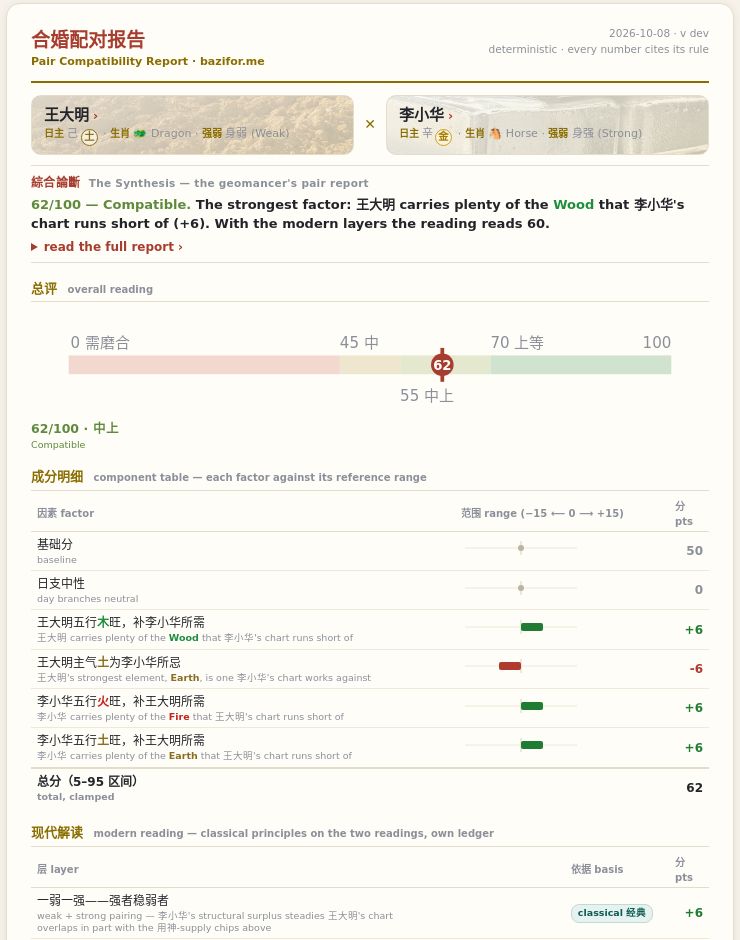
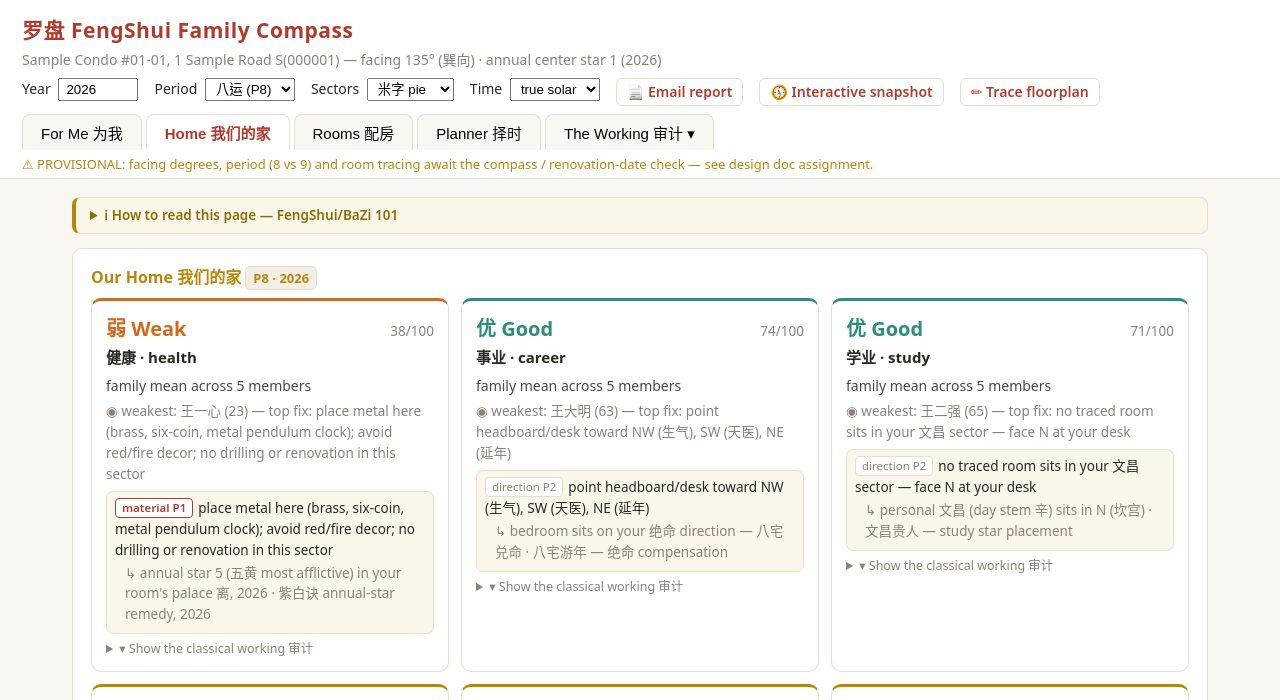
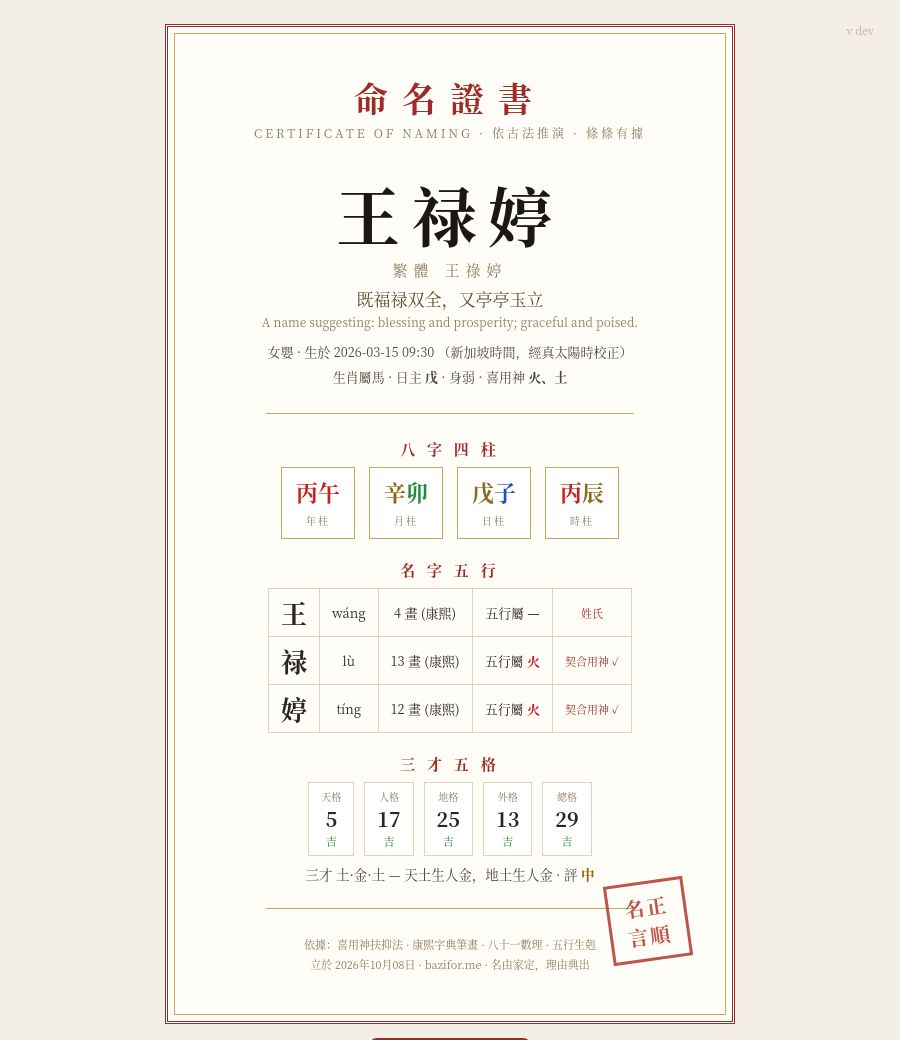
The reading: four pillars, Day Master and useful god, every number citing its rule.The pair report: a scored, printable compatibility sheet.The home view: room and aspect scores for a sample condo.The naming certificate: pillars, Five Grids and the name's elements.
Example screens use fictional data.
Why you can trust the numbers (为什么可信)
The engine reproduced a professionally produced, paid fengshui audit
to the digit — 27/27 flying-star palaces and 32/32 directional assignments — and
matches commercial BaZi chart products character-for-character on the calendar layer.
Determinism makes that test possible: run it twice, get the same answer, compare against
a benchmark. A chatbot can pass no such test.
Curious about the methods themselves? The Learn library explains
each layer — four pillars, useful god, Eight House, flying stars, date selection — in plain
language, in English and Chinese (中文).
See it on your own chart.
Free, no account, under a minute. Get your reading →