
Luck Cycles (大運) and Annual Windows: The Climate and Weather of a BaZi Chart
A birth chart is fixed, and BaZi models time with two moving layers on top of it. The luck cycles are ten-year pillars derived from the month pillar, and the annual pillar (annual year, 流年) changes every Start of Spring (立春). The decade is the climate, and the year is the weather inside it.
How are luck cycles worked out?
A luck cycle is a stem and branch pair that overlays the natal chart for ten years. The sequence starts from the month pillar and steps through the sixty-pair cycle. Two rules fix the direction and the start age.
The direction is yang men and yin women count forward (陽男陰女順行), yin men and yang women count backward (陰男陽女逆行). A yang-year man or a yin-year woman runs forward. A yin-year man or a yang-year woman runs backward. The start age is luck-cycle start (起運) = days to the solar-term boundary (距節日數) / 3, which means the days from birth to the nearest solar-term boundary (節), divided by three.
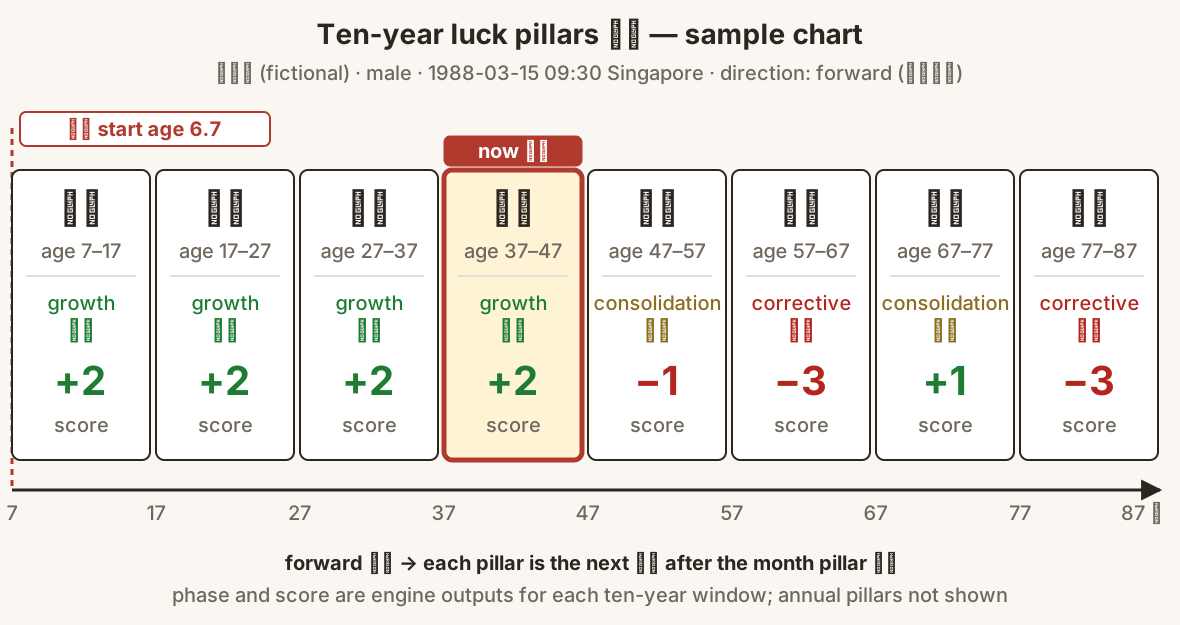
The sample is 王大明, a fictional man born 1988-03-15 at 09:30 in Singapore. His pillars are 戊辰 (Earth Dragon) 乙卯 (Wood Rabbit) 己巳 (Earth Snake) 戊辰, and his Day Master is 己 (yin Earth). His year stem 戊 (yang Earth) is yang, so he runs forward from the month pillar 乙卯. The count goes to the solar-term boundary of Clear and Bright (清明), and the start age comes out at 6.7.
Key facts
- Luck cycles step from the month pillar, forward or backward by the rule yang men and yin women count forward, yin men and yang women count backward.
- The start age is luck-cycle start = days to the solar-term boundary / 3, and the sample's is 6.7 (counted to the solar-term boundary Clear and Bright).
- The sample's current decade is 己未 (Earth Goat), ages 37-47, graded growth with a score of +2.
- The weakest decade ahead is 辛酉 ( Rooster), ages 57-67, graded corrective at -3, with a clash on the month branch 卯 (Rabbit, Wood).
- The 2027 year pillar 丁未 (Fire Goat) starts at Start of Spring on 2027-02-04, with career and health cautions and a study window.
- The year 2030 (庚戌, Dog) clashes open the sample's sealed wealth vault 辰 (Dragon, Earth).
See these rules applied to your own chart: free BaZi reading →
How is a decade graded?
Each decade's stem and branch are read against the chart's favourable and unfavourable elements. For the sample, the favourable elements are Fire (火) and Earth (土), and the unfavourable are Wood (木), Water (水) and . The engine also checks combinations and clashes between the decade branch and the natal pillars. The result is a phase label and a score.
Table 1: the sample's eight luck cycles
| Pillar | Ages | Phase | Score | Why |
|---|---|---|---|---|
| 丙辰 (Fire Dragon) | 7-17 | growth (成長) | +2 | stem 丙 (yang Fire) Fire and branch 辰 Earth favourable |
| 丁巳 (Fire Snake) | 17-27 | growth | +2 | stem 丁 (yin Fire) Fire and branch 巳 (Snake, Fire) Fire favourable |
| 戊午 (Earth Horse) | 27-37 | growth | +2 | stem 戊 Earth and branch 午 (Horse, Fire) Fire favourable |
| 己未 | 37-47 | growth | +2 | stem 己 Earth and branch 未 (Goat, Earth) Earth favourable (current) |
| 庚申 ( Monkey) | 47-57 | consolidation build-up (蓄勢) | -1 | both unfavourable, but Six Harmony (六合) with a core pillar steadies it |
| 辛酉 | 57-67 | corrective consolidation (修整) | -3 | both unfavourable, and 酉 (Rooster, ) clashes month branch 卯 |
| 壬戌 (Water Dog) | 67-77 | consolidation build-up | +1 | stem 壬 (yang Water) unfavourable, branch 戌 (Dog, Earth) favourable, Six Harmony steadies it |
| 癸亥 (Water Pig) | 77-87 | corrective consolidation | -3 | both unfavourable, and 亥 (Pig, Water) clashes day branch 巳 |
The labels and scores are the engine's own (method note). Two habits keep the reading honest. First, a corrective decade is not a bad life. It is a season with different work, such as maintenance, learning and pruning. Second, each decade brings its own gods. The sample's 庚申 decade brings Hurting Officer (傷官) on both stem and branch, a god that is nearly absent in his natal chart. The ten gods guide lists all eight pillars with their gods.
How are annual windows read?
Within a decade, each year is checked per life area, not given one verdict. The engine looks at career, wealth, relationship, health, study and movement. Each area shows one of three flags: a window, a caution, or quiet.
A window is a tailwind and a caution is a navigation note. Neither is a prediction. The flags come from fixed rules, such as the year branch combining with or clashing a natal pillar. Table 2 shows the sample's years from 2027 to 2030.
Table 2: selected annual flags for the sample
| Year | Pillar | Flags raised |
|---|---|---|
| 2027 | 丁未 | career caution (combines into Wood (合化木) feeds an unfavourable element); health caution (year feeds Earth excess); study window (Indirect Resource (偏印) arrives) |
| 2028 | 戊申 (Earth Monkey) | relationship caution (combines into Water (合化水) is unfavourable); health caution; study window; movement window (combination (合) day branch) |
| 2029 | 己酉 (Earth Rooster) | career caution (酉 clashes month 卯); relationship window (桃花 (romance star) year); study caution; health caution |
| 2030 | 庚戌 | career window (combination month pillar); wealth window (沖開財庫 辰); study window; movement caution (clashes year branch 辰) |
Read across a row, a year is mixed. 2030 offers a wealth window and a movement caution in the same twelve months. That is normal. The engine reports each area separately so you can plan around it.
What are the vault, the peach blossom and other timed stars?
Some chart features exist only as timing. The wealth vault (財庫) is the storage branch of your wealth element. The sample's wealth element is Water, and its vault is 辰, which is present in his chart but sealed. A vault opens in the year whose branch clashes it. For 辰 that is any 戌 year, so 庚戌 in 2030 is flagged as a classical accumulation year.
The peach blossom (桃花) branch governs attraction years. For the sample, whose year branch 辰 sits in the 申 (Monkey, )·子 (Rat, Water)·辰 group, the peach blossom branch is 酉. The 2029 year 己酉 therefore carries the relationship window. The symbolic stars guide lists the lookup tables behind these stars.
This is why two people with similar charts diverge. Their calendars strike different pillars at different ages.
See these rules applied to your own chart: free BaZi reading →
How do you use the timeline in practice?
Read the decade band first, to see where you are in the arc. Then read the current year's flags, area by area. Then plan against the next window. A short sequence works for most people.
- Find the current decade and its phase. For the sample in 2026, at age 38, it is 己未, growth.
- Check the year pillar for the year you are planning. For 2027 it is 丁未.
- Look only at the area you care about, such as career or study.
- Treat a caution as a reason to pace the decision, not to cancel it.
What changes for Singapore and Malaysia readers?
The luck sequence depends on exact birth data, so local time rules matter.
- Year boundary. The annual pillar changes at Start of Spring, not on 1 January. Start of Spring falls on 2026-02-04, 2027-02-04 and 2028-02-04. A birth in late January or early February may belong to the earlier year. That changes the year stem, its polarity and the direction of the luck cycles.
- Time zone. Singapore ran on UTC+7:30 before 1982-01-01 and UTC+8 after it. Malaysia has used UTC+8 since 1982-01-01. A wrong offset can move the birth across a solar-term boundary, which changes the start age.
- Start age. The start age depends on the distance to the solar-term boundary, so a birth close to a boundary can shift it by months.
- Moves. The movement flag is one input if you are changing homes. For an HDB flat or condominium unit, the move-in day itself is chosen by a separate filter, described in move-in date selection.
FAQ
What is a BaZi luck cycle (luck cycles)?
A luck cycle is a ten-year stem and branch pillar that overlays your natal chart. It is derived from the month pillar. The decade is the climate, and the annual pillar, which changes every Start of Spring, is the weather inside it.
How is the age my luck cycle starts calculated?
The start age is the days from birth to the nearest solar-term boundary, a solar-term boundary, divided by three. The direction is forward for a yang-year man or a yin-year woman, and backward otherwise. The sample's start age is 6.7.
Does a corrective decade mean a bad life?
No. A corrective decade is a season with different work, such as maintenance, learning and pruning. The labels and scores are the engine's own. A caution is a reason to pace a decision, not to cancel it.
How are annual windows and cautions read?
Each year is checked per life area: career, wealth, relationship, health, study and movement. Each area shows a window, a caution or quiet. A window is a tailwind and a caution is a navigation note. Neither is a prediction.
Why does my birth time zone change my luck cycles in Singapore or Malaysia?
Singapore ran on UTC+7:30 before 1982-01-01 and UTC+8 after it. A wrong offset can move a birth across a solar-term boundary, which changes the start age. The year also turns at Start of Spring, which can change the direction of the cycles.
Sources and method
- Luck sequence: yang men and yin women count forward, yin men and yang women count backward, starting from the month pillar.
- Start age: luck-cycle start = days to the solar-term boundary / 3.
- Decade grading: favourable and unfavourable elements from the useful god (用神) method, plus branch combinations and clashes (method note).
- Annual flags: fixed rules on the year branch against the natal pillars (method note).
- Branch relations: Six Harmony and Six Clash (六沖) tables as in 三命通會 (Ming-era BaZi classic), in the chapters the engine cites.
- Wealth vault: the storage branch of the wealth element, opened by its clash.
See your own decade band in the free reading at /start, and compare the timeline with the stars that mark it in symbolic stars.
Every line of a bazifor.me reading cites the classical rule that produced it. Deterministic engine, no account needed, workspace stays private.
Get your free reading →