BaZi vs MBTI and Modern Personality Tests: What Each Can and Cannot Tell You
A personality questionnaire asks how you describe yourself, and a BaZi chart is computed from when and where you were born. They take different inputs and answer different questions, so a fair comparison is about method, not about which one wins.
What is the difference in method?
A questionnaire such as MBTI, Big Five or DISC takes your answers as its input. By construction, it measures how you describe yourself on the day you answer. Self-report questionnaires can give different results on retest (method note), because mood, circumstances and self-image change.
The BaZi engine takes birth data: date, time, place and sex. Its computation is repeatable. The same birth data always gives the same chart, which is the first of the ten method claims published at /method. The engine converts the clock to true solar time, then casts the pillars. Take the sample, 王大明, a fictional man born 1988-03-15 at 09:30 in Singapore. His clock time becomes 08:16 and his pillars are 戊辰 (Earth Dragon) 乙卯 (Wood Rabbit) 己巳 (Earth Snake) 戊辰.
Repeatable is not the same as valid. Whether a chart maps to character is a separate claim. This site makes no claim that BaZi personality readings have been validated by psychology research (method note). The engine states only that it computes classical structures and gives their traditional reading.
Key facts
- A questionnaire takes self-report as input, and the BaZi engine takes birth date, time, place and sex.
- Self-report questionnaires can give different results on retest (method note), while the same birth data always gives the same chart.
- The engine's five personality axes are threshold rules on ten-god shares, such as Expression: output (食傷) at or below 5 % reads as reserved.
- The sample scores output 3.7 % (reserved) and Seven Killings (七殺) plus Rob Wealth (劫財) at 77.8 %, which clears the 25 % bar for decisive.
- The engine does not predict events, and no generative AI writes any reading.
- Luck cycles add a time axis: the sample's current decade is 己未 (Earth Goat), ages 37-47.
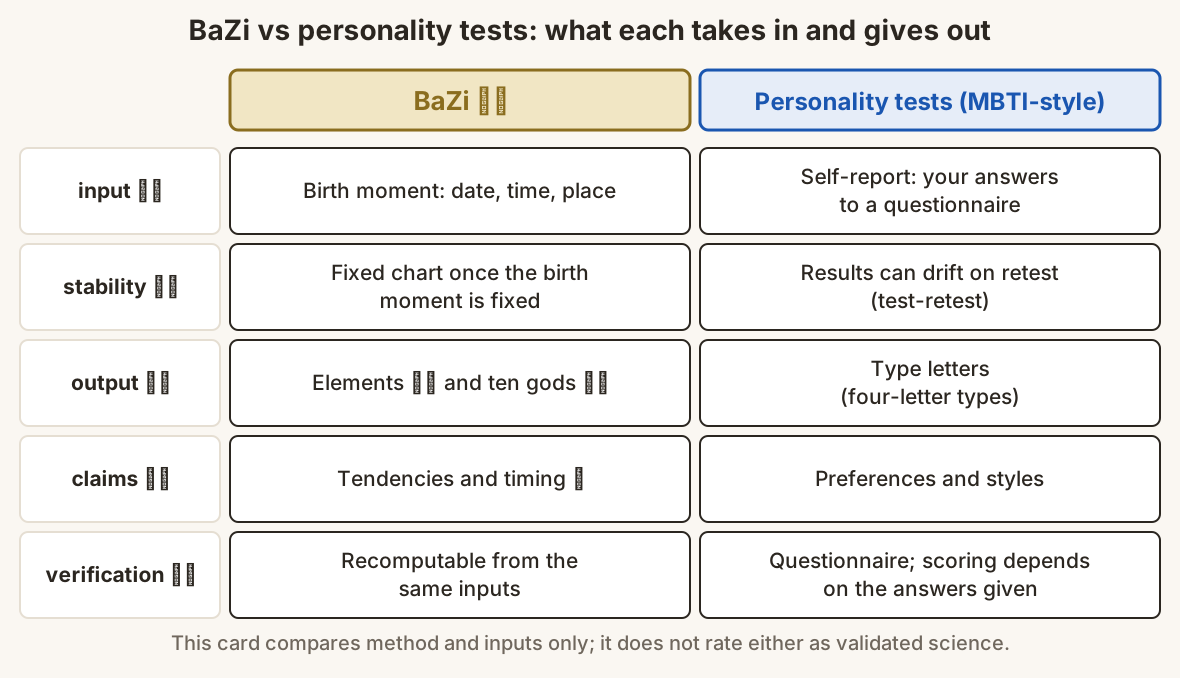
Table 1: the two methods side by side
| Feature | Self-report questionnaire | BaZi engine |
|---|---|---|
| Input | your answers on the day | birth date, time, place and sex |
| Repeatable | can differ on retest (method note) | same input, same output |
| Output | a type or score profile | pillars, element balance, ten gods, strength |
| Time axis | none built in | Luck cycles (大運) and annual pillars |
| Basis stated | the instrument's own model | a named classical rule per line |
| Event prediction | not its purpose | not claimed; the engine does not predict events |
| Psychology validation | the instrument's own literature | none claimed (method note) |
See these rules applied to your own chart: free BaZi reading →
How does the engine turn a chart into a personality statement?
It does it by threshold rules on the ten-god percentages, not by free text. The engine reads five axes. Each has a stated basis, so you can see exactly why a verdict appeared. Table 2 shows the sample.
Table 2: the sample's five personality axes
| Axis | Engine verdict | Stated basis |
|---|---|---|
| Expression (表達) | reserved output | Output 4 % (at least 20 % expressive, at most 5 % reserved) |
| Action (行動) | decisive, acts under pressure | Seven Killings plus Rob Wealth 78 % (at least 25 % decisive, at most 8 % deliberate) |
| Authority stance authority (權威) | works within structure | Authority (官殺) 30 %, Hurting Officer (傷官) 4 % |
| Thinking style thinking (思維) | no strong tendency | Resource (印) 11 % against wealth (財) 7 % (25 % and larger wins) |
| Emotional display feelings (情感) | direct and open | Peers (比劫) 48 %, with resource 11 % and output 4 % |
The thresholds are the engine's own (method note). They are choices, written down, and open to challenge. That is the closest BaZi gets to a scoring key. The inputs behind them are the sample's ten-god shares: Rob Wealth 48.1 %, Seven Killings 29.6 %, Direct Resource (正印) 11.1 %, Indirect Wealth (偏財) 7.4 % and Hurting Officer 3.7 %. The ten gods guide shows where those shares come from.
Notice the difference in kind. A questionnaire result is a position on a scale built from your answers. The engine's verdict is a reading of structure. The engine's own caveat on the sample's Day Master 己 (yin Earth) is that strength measures balance, not ability.
What does each approach do well?
A questionnaire gives you a shared vocabulary for how you see yourself now. That suits team conversations and self-reflection at a particular moment. Its limits are the ones above: it records your self-image, and your self-image moves.
The BaZi engine does three things a questionnaire does not try to do.
- It is stable. The chart is a fixed reference built from birth data, not a snapshot of mood.
- It is structural. It expresses strengths and gaps as element balances and names favourable elements. The sample is score -0.97 (身弱), and the engine lists Fire (火) and Earth (土) as favourable.
- It has a time axis. It grades each ten-year luck cycle and flags annual windows. The sample's 己未 decade (ages 37-47) is graded growth, and his 辛酉 ( Rooster) decade (ages 57-67) is graded corrective.
The same chart also drives other layers, such as the Eight House directions and date selection. For the sample, the Eight House type is 震命 (kua 3, East group), the East group. One birth record feeds personality notes, timing and home layout.
What should neither approach claim?
Neither should claim to settle who you are. A questionnaire type is a summary of answers. A chart is a map of classical structure. The engine says it does not predict events, and it records choices where schools differ and marks them as disputed.
A careful reader treats both as lenses.
See these rules applied to your own chart: free BaZi reading →
How can you use both together?
Use the questionnaire for what it records: your current self-description. Use the chart for what it computes: structure and timing. Then compare.
- Write down the questionnaire result and the date you took it.
- Open your chart and note the five axes and their stated bases.
- Mark where the two agree and where they differ.
- For each difference, ask whether circumstances are masking the structure, or whether the chart's reading simply does not fit you.
Either answer is useful. A mismatch is a question, not an error. Because the chart's rules are written down, you can test a verdict against your own life and decide it does not apply. That is a feature of a rule-based reading.
What changes for Singapore and Malaysia readers?
A BaZi comparison is only as good as the birth data, so local time rules matter more than for a questionnaire.
- Year boundary. The BaZi year turns at Start of Spring (立春), not on 1 January. In 2027, Start of Spring falls on 2027-02-04. A birth in late January may belong to the earlier year, and that changes the pillars and every axis downstream.
- Time zone. Singapore ran on UTC+7:30 before 1982-01-01 and UTC+8 after it. Malaysia has used UTC+8 since 1982-01-01. The method page states that clock times before 1982 use the offset of that era.
- True solar time. The engine adjusts for longitude and the equation of time. The sample's 09:30 became 08:16, using longitude 103.8517°E.
- Unknown hour. If the hour is uncertain, run the chart with a few candidate times and see whether the hour pillar changes. If it does not, the doubt does not matter.
FAQ
Is BaZi more accurate than MBTI?
The two take different inputs, so accuracy is not a fair comparison. A questionnaire records how you describe yourself on the day. BaZi computes a repeatable chart from birth data. Repeatable is not the same as valid, and no psychology validation is claimed.
Why does my MBTI result change when I retake it?
Self-report questionnaires can give different results on retest, because mood, circumstances and self-image change. A BaZi chart does not move this way. The same birth data always gives the same chart.
What birth details do I need for a BaZi chart in Singapore or Malaysia?
You need the birth date, time, place and sex. Singapore ran on UTC+7:30 before 1982-01-01 and UTC+8 after it. Malaysia has used UTC+8 since 1982-01-01. Local time rules matter more here than for a questionnaire.
Does BaZi predict events or tell me who I am?
No. The engine says it does not predict events, and no generative AI writes any reading. A chart is a map of classical structure. Neither a chart nor a questionnaire settles who you are, so treat both as lenses.
Can I use a personality test and a BaZi chart together?
Yes. Write down your questionnaire result and date, then note the chart's five axes and their stated bases. Mark where they agree and differ. A mismatch is a question, not an error.
Sources and method
- Method claims: the ten claims at /method, covering determinism, rule ids per line, true solar time and no generative AI (method note).
- Personality axes: the engine's threshold rules on ten-god shares (method note).
- Ten gods: the 子平 (classical BaZi school) convention of relating each stem to the Day Master.
- Strength and favourable elements: seasonal strength (旺相休囚死) with rooting (通根), and support-and-restrain method (扶抑法) and climate-adjustment method (調候法).
- Luck cycles: yang men and yin women count forward (陽男陰女順行), yin men and yang women count backward (陰男陽女逆行), with luck-cycle start (起運) = days to the solar-term boundary (距節日數) / 3.
- Questionnaires: the only claim made is that self-report questionnaires can give different results on retest (method note).
Bring your own questionnaire result and compare it with your chart in the free reading at /start. For how the chart is computed, read is BaZi deterministic.
Every line of a bazifor.me reading cites the classical rule that produced it. Deterministic engine, no account needed, workspace stays private.
Get your free reading →