Ten Gods (十神) Explained: Meanings, Groups and Luck Cycles for 己 (yin Earth)
The Ten Gods are the ten relationships any stem can have to your Day Master. Each is a pair of one element role split by yin and yang polarity: peers, output, wealth, authority and resource. Every visible or hidden stem, and every luck pillar, falls into one of the ten.
What are the ten gods, and how are they grouped?
They come in five pairs, one pair per elemental role. The engine names the groups peers (比劫), output (食傷), wealth (財), authority (官殺) and resource (印). The 正 god of a pair is the conventional, steady flavour; its partner is the intense, unconventional one, powerful when channelled and costly when not.
Which god a stem is depends on your Day Master. Table 1 is the full list for Day Master 己, with the group and the engine's meaning for each god.
Key facts
- There are 10 gods in 5 groups: peers, output, wealth, authority and resource.
- For Day Master 己, the stem 甲 (yang Wood) is Direct Officer (正官) and the stem 乙 (yin Wood) is Seven Killings (七殺).
- The sample chart's distribution is Rob Wealth (劫財) 48.1 %, Seven Killings 29.6 %, Direct Resource (正印) 11.1 %, Indirect Wealth (偏財) 7.4 % and Hurting Officer (傷官) 3.7 %.
- The sample's current luck pillar is 己未 (Earth Goat) for ages 37-47, with Friend (比肩) on both stem and branch.
- The luck sequence runs forward from the month pillar 乙卯 (Wood Rabbit) and starts at age 6.7, by the rule yang men and yin women count forward (陽男陰女順行) with luck-cycle start (起運) = distance to the solar-term boundary (節) divided by 3.
- The 2027 year pillar is 丁未 (Fire Goat) from Start of Spring (立春), 2027-02-04, and 丁 (yin Fire) is Indirect Resource (偏印) for a 己 Day Master.
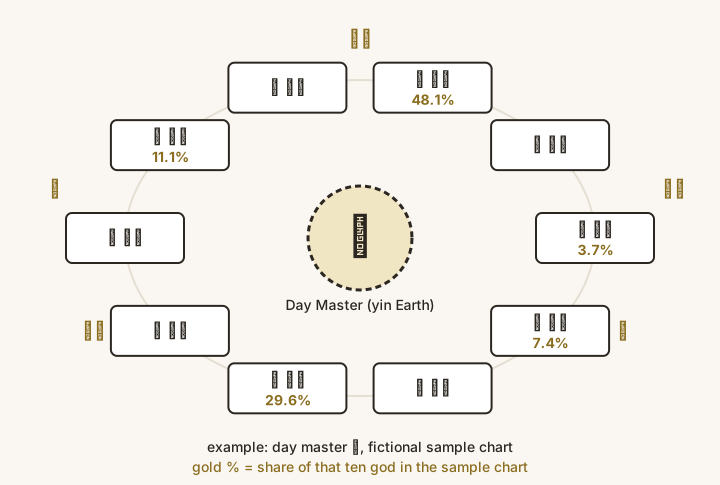
Table 1: the ten gods for Day Master 己
| Stem | God | Group | Engine meaning |
|---|---|---|---|
| 甲 | Direct Officer | Authority | proper authority: rules, status, responsibility (spouse star in a woman's chart) |
| 乙 | Seven Killings | Authority | raw pressure: ambition, decisiveness, discipline imposed from outside |
| 丙 (yang Fire) | Direct Resource | Resource | nurturing support: study, protection, elders, credentials |
| 丁 | Indirect Resource | Resource | unconventional learning: intuition, niche skills, solitary study |
| 戊 (yang Earth) | Rob Wealth | Peers | rivals & boldness: shared resources, competition, risk appetite |
| 己 | Friend | Peers | peers & self-reliance: siblings, equals, standing your ground |
| 庚 () | Hurting Officer | Output | sharp output: brilliance, critique, rebellion against rules |
| 辛 () | Eating God (食神) | Output | gentle output: enjoyment, nurture, easy creativity |
| 壬 (yang Water) | Direct Wealth (正財) | Wealth | steady wealth: salary, prudence, savings (spouse star in a man's chart) |
| 癸 (yin Water) | Indirect Wealth | Wealth | windfall wealth: opportunity, generosity, business flair |
Wealth and authority carry a second meaning in the classics: wealth is the spouse star in a man's chart and authority is the spouse star in a woman's chart. The gods also stand for people (family roles, 六親): wealth for the father, resource for the mother and mentors, peers for siblings.
See these rules applied to your own chart: free BaZi reading →
What are the bright and shadow sides of each god?
Every god has a bright side and a shadow side. The shadow shows when the god is excessive or unsupported, so a prominent god is both your engine and your watch-list.
Table 2: bright and shadow sides
| God | Bright side | Shadow side |
|---|---|---|
| Direct Resource | broad learning, kindness, quiet support | over-reliance, idealism, indecision |
| Indirect Resource | deep insight in niche fields, original self-taught skill | solitary, suspicious, keeps people at arm's length |
| Direct Officer | responsibility, order, stable social standing | conservatism, rule-bound pressure and anxiety |
| Seven Killings | leadership in adversity, execution, pioneering | impulsiveness; health and legal risks |
| Friend | confident, loyal, natural team player | stubborn over spoils, self-centred splits |
| Rob Wealth | strong social drive, dares to take risks | impulsive losses, easily talked into traps |
| Eating God | overflowing talent, easy-going, deep bond with children | comfort-seeking, weak follow-through, indulgence |
| Hurting Officer | innovation, eloquence, artistic force | rebellious, attracts resentment, marriage friction |
| Direct Wealth | diligence, steady income, loyalty | stingy, conservative, material over spirit |
| Indirect Wealth | keen money sense, generosity, seizes windfalls | extravagance, tangled romantic affairs |
The classical "four benign" gods are Direct Officer, Direct Resource, Direct Wealth and Eating God. The "four fierce" are Seven Killings, Hurting Officer, Indirect Resource and Rob Wealth.
How do you read a distribution chart?
A distribution chart weighs every visible and hidden stem and shows how the chart's energy divides among the ten. Three habits make it useful.
- Heavy bars are engine and watch-list. A god with a large share is real strength and real pressure at once.
- Empty bars are not doom. A missing god is a domain that does not run on autopilot, not a curse. No peers means self-drive must be deliberate, and no authority means structure has to be chosen.
- Percentages start the reading, structure finishes it. Whether the heavy god sits on a favourable element, whether it is rooted in a branch, and what the gods form together decide how the weight behaves.
What does the sample chart show?
The sample person is 王大明, male, born 1988-03-15 at 09:30 in Singapore, with pillars 戊辰 (Earth Dragon) 乙卯 己巳 (Earth Snake) 戊辰 and Day Master 己. The engine's distribution is Rob Wealth 48.1 %, Seven Killings 29.6 %, Direct Resource 11.1 %, Indirect Wealth 7.4 % and Hurting Officer 3.7 %. The other five gods do not appear in the engine's list.
By group, peers carry 48.1 %, authority 29.6 %, resource 11.1 %, wealth 7.4 % and output 3.7 %. The engine's personality axes read from these shares:
- Expression: reserved output, because output is 4 % (the engine calls 5 % or less reserved).
- Action: decisive and acts under pressure, because Seven Killings plus Rob Wealth is 78 %.
- Authority stance: works within structure, with authority at 30 % and Hurting Officer at 4 %.
- Thinking style: no strong tendency, with resource at 11 % against wealth at 7 %.
- Emotional display: direct and open, with peers at 48 %.
These thresholds are the engine's own (method note). The chart's weak Day Master (身弱, score -0.97) is the context for reading the heavy Rob Wealth and Seven Killings shares.
See these rules applied to your own chart: free BaZi reading →
How do the gods arrive with time?
The chart is the cast and the calendar is the schedule. Each ten-year luck pillar (luck cycles, 大運) carries a stem god and a branch god for your Day Master. The sample runs forward because the rule is yang man, yin woman forward, and it starts at age 6.7, counted as the distance to the next solar-term boundary divided by 3.
Table 3: the sample's luck pillars
| Pillar | Ages | Stem god | Branch god | Keywords |
|---|---|---|---|---|
| 丙辰 (Fire Dragon) | 7-17 | Direct Resource | Rob Wealth | learning & support |
| 丁巳 (Fire Snake) | 17-27 | Indirect Resource | Direct Resource | intuition & niche skills |
| 戊午 (Earth Horse) | 27-37 | Rob Wealth | Indirect Resource | competition & bold moves |
| 己未 | 37-47 | Friend | Friend | self-drive & peers (current) |
| 庚申 ( Monkey) | 47-57 | Hurting Officer | Hurting Officer | expression & disruption |
| 辛酉 ( Rooster) | 57-67 | Eating God | Eating God | enjoyment & easy output |
The current pillar 己未 puts Friend on both stem and branch, which the engine reads as self-drive and peers. The next, 庚申 from age 47, brings Hurting Officer twice, the god that is nearly absent in the natal chart.
What changes for Singapore and Malaysia readers?
Annual years bring their own god. The 2027 year pillar is 丁未, and 丁 is Indirect Resource for a 己 Day Master, so the year carries unconventional learning and niche skills. The year turns at Start of Spring, 2027-02-04, so a Singapore or Malaysia birth in late January or early February may sit in the earlier year and change every god. Clock time matters too: Singapore ran on UTC+7:30 before 1982-01-01 and UTC+8 after it, and Malaysia has used UTC+8 since 1982-01-01. A shifted hour pillar changes the distribution.
FAQ
What are the Ten Gods in BaZi?
The Ten Gods are the ten relationships any stem can have to your Day Master. They come in five pairs: peers, output, wealth, authority and resource. Every visible or hidden stem, and every luck pillar, falls into one of the ten.
Which Ten Gods are benign and which are fierce?
The classical four benign gods are Direct Officer, Direct Resource, Direct Wealth and Eating God. The four fierce gods are Seven Killings, Hurting Officer, Indirect Resource and Rob Wealth. Every god has a bright side and a shadow side, which shows when it is excessive or unsupported.
Does a missing god in my chart mean bad luck?
No. Empty bars are not doom. A missing god is a domain that does not run on autopilot, not a curse. No peers means self-drive must be deliberate, and no authority means structure has to be chosen.
How do I read a Ten Gods percentage chart?
A distribution chart weighs every visible and hidden stem. A heavy bar is both your engine and your watch-list. Percentages start the reading, and structure finishes it, such as whether the heavy god sits on a favourable element.
Why can my birth details change my Ten Gods in Singapore or Malaysia?
The year turns at Start of Spring, so a late January or early February birth may sit in the earlier year and change every god. Singapore ran on UTC+7:30 before 1982-01-01 and UTC+8 after it. A shifted hour pillar changes the distribution.
Sources and method
- Ten gods and their groups: the 子平 (classical BaZi school) convention of relating each stem to the Day Master by element and polarity, as listed in Table 1; the group names are the engine's.
- Meanings: the engine's own wording for each god (method note).
- Bright and shadow sides: the bazifor.me guide text (method note).
- Distribution and personality axes: the engine's weighted percentages and thresholds (method note).
- Luck pillars: yang men and yin women count forward, yin men and yang women count backward (陰男陽女逆行), with luck-cycle start = days to the solar-term boundary (距節日數)/3.
- Stem relationships: 三命通會 (Ming-era BaZi classic), in the chapters the engine cites.
See the gods in your own chart in the free reading at /start, and how luck pillars unfold in luck cycles and windows.
Every line of a bazifor.me reading cites the classical rule that produced it. Deterministic engine, no account needed, workspace stays private.
Get your free reading →