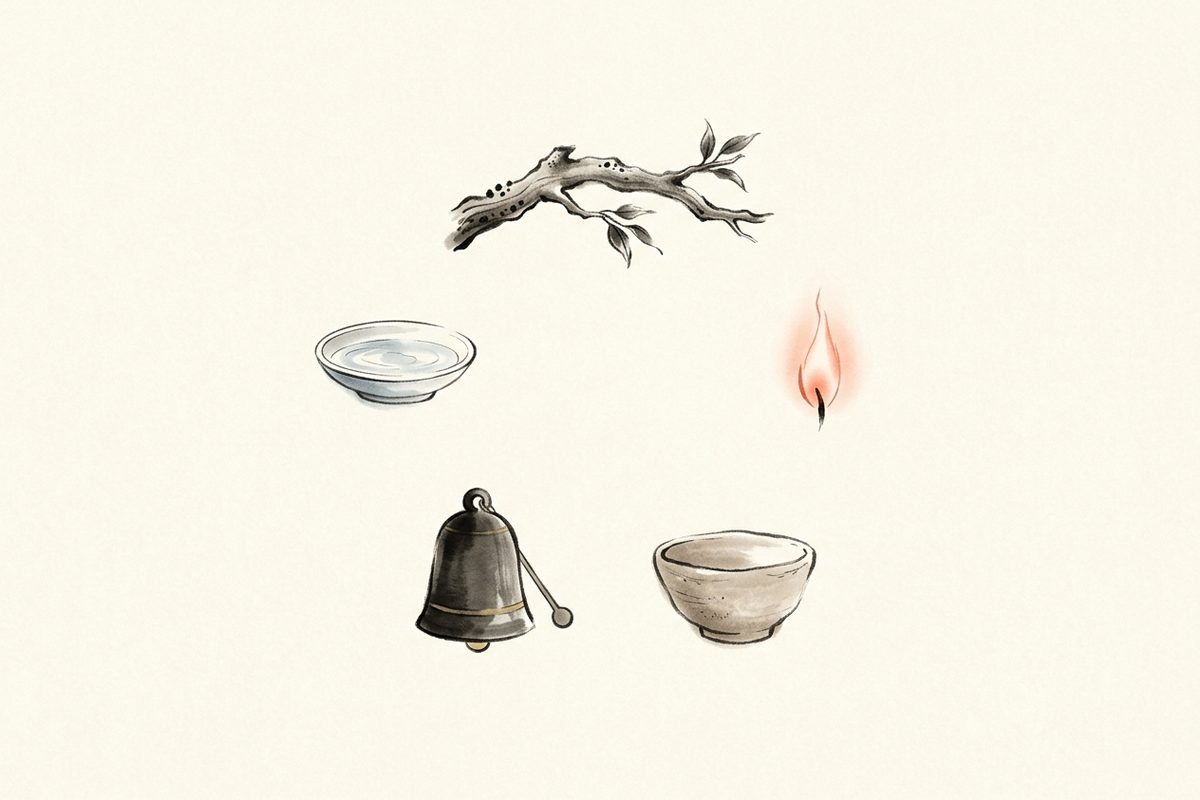
The Five Elements in a BaZi Chart: Balance, the feed-and-control cycles (生克) Cycles, and What Excess Means
BaZi treats a chart as a five-element ecosystem of Wood (木), Fire (火), Earth (土), and Water (水). Every stem, branch and hidden stem carries one element, and a weighted count of all of them gives the chart's element balance.
How are the five elements counted in a chart?
The engine gives each stem, including the Day Master, a weight of 1.0. Each branch adds 1.0 for its main hidden stem and one third for each minor hidden stem (method note). It then adds the weights per element. The sample chart is 王大明, a fictional man born 1988-03-15 at 09:30 in Singapore, with pillars 戊辰 (Earth Dragon) 乙卯 (Wood Rabbit) 己巳 (Earth Snake) 戊辰 and Day Master 己 (yin Earth).
His weights total 10.0: Wood 2.67, Fire 1.0, Earth 5.33, 0.33 and Water 0.67. As shares, Earth is 53.3 %, Wood 26.7 %, Fire 10.0 %, Water 6.7 % and 3.3 %. The habit that matters most is to read these as balance, not as a score. The tallest bar is the heaviest influence, not the best one, and the shortest bar is where the ecosystem is thin.
Key facts
- The five elements are Wood, Fire, Earth, and Water, and every stem and branch belongs to one of them.
- The feeding cycle (generates, 生) runs Wood→Fire→Earth→→Water→Wood, and the controlling cycle (controls, 剋) runs Wood→Earth→Water→Fire→→Wood.
- The sample's weights are Wood 2.67, Fire 1.0, Earth 5.33, 0.33 and Water 0.67, totalling 10.0.
- In shares, Earth is 53.3 % and is only 3.3 %, which the engine bands as absent.
- The engine finds two frictions: Earth over Water, and Wood over Earth.
- The favourable elements are Fire and Earth (support-and-restrain method (扶抑法) and climate-adjustment method (調候法)), with colours red (紅), purple (紫), yellow (黃) and brown (棕).
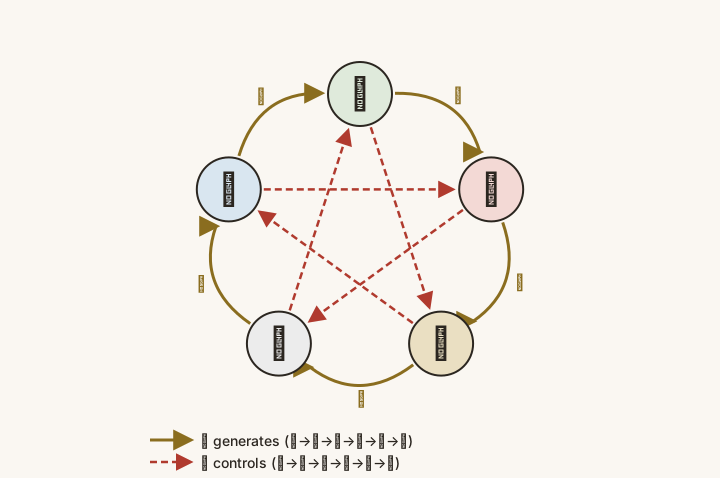
Table 1: the five elements and their engine traits
| Element | Engine trait | Organs the engine lists | Sample share |
|---|---|---|---|
| Wood | pioneering, growth-driven, initiating | liver, gallbladder | 26.7 % |
| Fire | expressive, social, leadership-leaning | heart, small intestine | 10.0 % |
| Earth | steady, reliable, grounding | spleen, stomach | 53.3 % |
| structured, precise, disciplined | lungs, large intestine | 3.3 % | |
| Water | reflective, adaptive, communicative | kidneys, bladder | 6.7 % |
The organ column is a traditional reference layer, not medical advice. Section five returns to it.
See these rules applied to your own chart: free BaZi reading →
How do the two cycles work?
The elements interact along two fixed cycles. In the feeding cycle (相生), each element generates the next. Wood feeds fire, fire makes earth, earth bears metal, metal carries water, and water nourishes wood. In the controlling cycle (相剋), each element checks another, the way a dam checks a river.
Both cycles are neutral machinery. Control is structure, not harm. Trouble appears when weights are lopsided. A very heavy element crushes the one it controls, which is a friction. A very weak element cannot feed the one downstream of it, which is a gap. The engine attaches a fixed sentence to each pair.
Table 2: the cycle pairs and the engine's wording
| Pair | Cycle | Engine meaning |
|---|---|---|
| Wood to Fire | feeds | ideas and growth fuel expression |
| Fire to Earth | feeds | action settles into stability and routine |
| Earth to | feeds | routine sharpens discipline and follow-through |
| to Water | feeds | structure deepens insight and adaptability |
| Water to Wood | feeds | reflection feeds growth and initiative |
| Wood over Earth | controls | growth overruns stability, plans trample routines |
| Earth over Water | controls | caution dams flow, communication and adaptability get blocked |
| Water over Fire | controls | overthinking damps enthusiasm and visibility |
| Fire over | controls | urgency melts discipline, structure gives way under passion |
| over Wood | controls | structure prunes growth, rules and rigidity cut initiative |
A friction is a recurring theme, not an event. Once it is named, it can be managed, usually by strengthening a buffer element that drains the aggressor and feeds the victim.
What are the five roles around your Day Master?
Relative to your Day Master, the other four elements take fixed roles. The element that feeds you is your resource (印). The one you produce is your output (食傷). The one you control is your wealth (財). The one that controls you is your pressure or authority (官殺). Your own element is your peers (比劫).
For the sample, the Day Master 己 is Earth, so the roles fall as follows.
Table 3: element roles for Day Master 己
| Role | Element | Share | Band | Engine meaning |
|---|---|---|---|---|
| Peers | Earth | 53.3 % | heavy | self-strength, siblings, competition |
| Pressure authority | Wood | 26.7 % | heavy | discipline, career pressure, external structure |
| Resource | Fire | 10.0 % | present | support, learning, protection, your recharge line |
| Wealth | Water | 6.7 % | faint | results the chart can seize and hold |
| Output | 3.3 % | absent | expression and output, spends your energy |
These five roles are what the ten gods refine one level further. The element wheel and the ten-god chart are the same picture at two zoom levels.
What does the sample chart's balance mean?
The engine writes its findings as short sentences, each tied to a cycle. For the sample it reports five.
- Earth dominates at 53.3 %, so steady, reliable, grounding colours the whole chart, and its excesses are the first faults to watch.
- is effectively absent at 3.3 %, so structure and follow-through need deliberate effort. The chain into Water also loses its feeder.
- Earth at 53.3 % bears down on weak Water at 6.7 %, so caution dams flow and communication gets blocked.
- Wood at 26.7 % stands against Earth at 53.3 %, so growth overruns stability. The engine calls this a recurring theme, manageable once named.
- The support line is intact: Fire at 10.0 % feeds Earth, so help and recovery are structurally available.
Absence has a fixed cost in the engine's wording. A missing means structure and follow-through need deliberate effort. A missing Wood would mean initiative and fresh starts need deliberate effort. A missing Water would mean adaptability and communication need deliberate effort. None of these is a curse. Each marks a job that does not run on autopilot.
See these rules applied to your own chart: free BaZi reading →
How do elements map to health and daily choices?
Traditional five-element medicine links each element to organ systems. The engine marks a very weak or very heavy element as a system worth caring for. In the sample, Earth is flagged as excess (過旺), covering spleen, stomach, digestion and overthinking. and Water are flagged as weak (deficient, 不足), covering lungs, skin, kidneys and bones. Wood and Fire are balanced. This is a reference layer and never medical advice.
The practical levers are gentler. The engine judges the Day Master weak (weak Day Master, 身弱, score -0.97), so its medicine feeds and protects: Fire and Earth. These translate into colours (red, purple, yellow, brown), room sectors and work settings. The favourable elements guide explains that step.
What changes for Singapore and Malaysia readers?
The element count depends on the four pillars, so anything that shifts a pillar shifts the balance.
- Year boundary. The BaZi year turns at Start of Spring (立春), which falls on 2027-02-04 in 2027. A birth in late January or early February may belong to the previous year, with a different year pillar and a different count.
- Time zone. Singapore used UTC+7:30 before 1982-01-01 and UTC+8 after it. Malaysia has used UTC+8 since 1982-01-01. A wrong offset can move the hour pillar and change two of the eight characters.
- True solar time. The engine converts the clock to true solar time. The sample's 09:30 became 08:16 before the hour pillar was cast.
- Homes. For an HDB flat or condominium unit, element advice applies to what you control, such as the colour of a study wall or bedding. You do not need to renovate.
FAQ
How are the five elements counted in a BaZi chart?
Each stem, including the Day Master, weighs 1.0. Each branch adds 1.0 for its main hidden stem and one third for each minor hidden stem. The engine adds the weights per element and reads the result as balance, not as a score.
What is the difference between the generating and controlling cycles?
In the feeding cycle (generates), each element generates the next, so wood feeds fire and fire makes earth. In the controlling cycle (controls), each element checks another, the way a dam checks a river. Control is structure, not harm.
What does a missing element in my chart mean?
Absence is not a curse. In the engine's wording, a missing metal means structure and follow-through need deliberate effort. A missing wood means initiative needs effort, and a missing water means adaptability and communication need effort.
Can I use the five elements for colours at home in Singapore or Malaysia?
Yes, in a gentle way. The favourable elements translate into colours, room sectors and work settings. In an HDB flat or condo, apply them to what you control, such as a study wall colour or bedding. You do not need to renovate.
Why does my birth year or hour change my element balance?
The element count depends on the four pillars. The BaZi year turns at Start of Spring, not on 1 January. A wrong time zone offset can move the hour pillar and change two of the eight characters.
Sources and method
- Cycles: the element cycles (五行生剋), applied to the chart's weighted element balance.
- Weights and bands: the engine's own weighting and band thresholds (method note).
- Frictions and absences: the engine's fixed sentences for each pair, listed in Table 2.
- Favourable elements: support-and-restrain method and climate-adjustment method, two of the four useful god (用神) methods.
- Health map: a traditional organ correspondence, offered as reference only (method note).
- Strength framework: seasonal strength (旺相休囚死) with rooting (通根).
Find your own element balance in the free reading at /start, and see how the roles become gods in ten gods explained.
Every line of a bazifor.me reading cites the classical rule that produced it. Deterministic engine, no account needed, workspace stays private.
Get your free reading →