Day Master (日主) Explained: The Ten Stems and Your Chart Strength
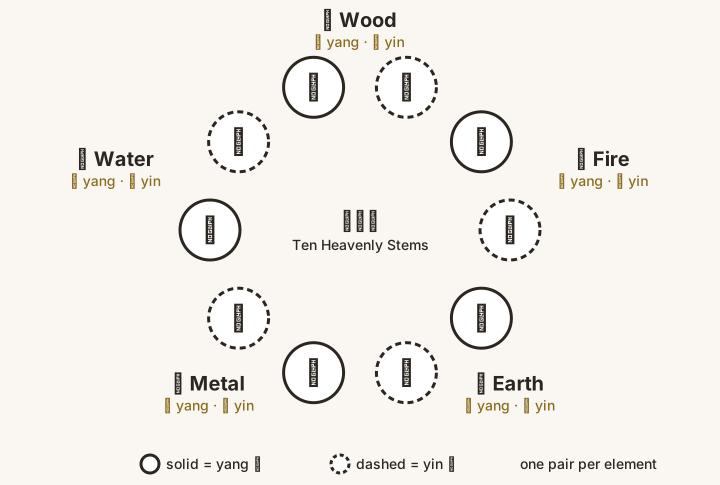
A Day Master (also called 日元) is the Heavenly Stem of your day pillar, the single character that stands for you in a BaZi chart. Every other stem, branch, luck cycle and year is read in relation to it. There are exactly ten possible Day Masters: five elements, each in a yang and a yin form.
What does the Day Master actually decide?
A BaZi chart has eight characters, and seven of them are defined by their relationship to the eighth. That relationship is what the Ten Gods (十神) record, and it is also what decides whether the chart is strong or weak, which elements help you, and which colours and directions the home layer later recommends.
The Day Master is computed, not chosen. It comes from the 60-day 甲子 (Wood Rat) cycle, so the same stem returns on a fixed rhythm every 10 days.
Key facts
- There are 10 Day Masters: 5 elements, each in a yang and a yin form, drawn from the 10 Heavenly Stems.
- The sample chart 戊辰 (Earth Dragon) 乙卯 (Wood Rabbit) 己巳 (Earth Snake) 戊辰 has Day Master 己 (yin Earth), yin earth.
- The sample birth time of 09:30 on the Singapore clock becomes 08:16 true solar time (UTC+8, longitude 103.8517°E, equation of time -9.4 minutes).
- The engine rates the sample chart weak Day Master (身弱) with a score of -0.97, a season state of dead (死) and roots 辰 (Dragon, Earth) 巳 (Snake, Fire) 辰.
- The sample's favourable elements are Fire (火) and Earth (土), from technique 1 of 4 (扶抑法) and technique 2 of 4 (調候法).
- The year in a chart turns at Start of Spring (立春), which falls on 2027-02-04 in 2027.
See these rules applied to your own chart: free BaZi reading →
Which of the ten stems is yours?
Read your day pillar from a chart calculator, then find its upper character here. The table pairs each stem with its element and polarity, and adds one short clause for temperament. The engine holds trait text per element, not per stem, so each clause is the element's trait plus a polarity label (method note).
| Stem | Element | Polarity | Trait clause (method note) |
|---|---|---|---|
| 甲 (yang Wood) | Wood (木) | yang (陽) | outward-facing form of: pioneering, growth-driven, initiating |
| 乙 (yin Wood) | Wood | yin (陰) | inward-facing form of: pioneering, growth-driven, initiating |
| 丙 (yang Fire) | Fire | yang | outward-facing form of: expressive, social, leadership-leaning |
| 丁 (yin Fire) | Fire | yin | inward-facing form of: expressive, social, leadership-leaning |
| 戊 (yang Earth) | Earth | yang | outward-facing form of: steady, reliable, grounding |
| 己 | Earth | yin | inward-facing form of: steady, reliable, grounding |
| 庚 () | yang | outward-facing form of: structured, precise, disciplined | |
| 辛 () | yin | inward-facing form of: structured, precise, disciplined | |
| 壬 (yang Water) | Water (水) | yang | outward-facing form of: reflective, adaptive, communicative |
| 癸 (yin Water) | Water | yin | inward-facing form of: reflective, adaptive, communicative |
The stems run in element pairs: 甲 乙 wood, 丙 丁 fire, 戊 己 earth, 庚 辛 metal and 壬 癸 water, yang first and yin second. If you know your element, only the polarity is left to pin down, and the pair shares its trait text in the engine.
Two cautions apply. A stem is one character of eight, so the Day Master describes a starting temperament and not a verdict. And two people with the same Day Master can read very differently, because strength and favourable elements depend on the other seven characters.
How is Day Master strength judged?
Strength asks whether the Day Master has enough support, or too much to carry. The engine follows the seasonal strength (旺相休囚死) framework from the 三命通會 (Ming-era BaZi classic) tradition together with rooting (通根).
- Season. The month branch gives the Day Master one of five states, prosperous (旺), assisting (相), resting (休), confined (囚) or dead.
- Roots. A stem is rooted (rooting) when branches in the chart carry its own element. Roots keep a seasonally weak Day Master from collapsing.
- Support against drain. Characters of the same element or the element that produces it count as support. Characters that exhaust, control or consume it count as drain.
- A numeric score. The engine combines these into one signed score (method note). Negative means weak (weak Day Master), positive means strong (strong Day Master, 身強).
The strength verdict then drives the useful god (用神), the favourable elements. The engine uses four techniques, support and restrain (扶抑), climate adjustment (調候), bridging element (通關) and disease and remedy (病藥), and cites which one fired.
See these rules applied to your own chart: free BaZi reading →
What does a worked chart look like?
The sample person is 王大明, male, born 1988-03-15 at 09:30 in Singapore. His pillars are 戊辰 (year), 乙卯 (month), 己巳 (day) and 戊辰 (hour). The day stem is 己, so his Day Master is yin earth, the soft, absorbing form of earth. The engine's trait text for earth reads steady, reliable, grounding.
The engine rates him weak Day Master with a score of -0.97. The season state is dead, because earth is dead in a wood month, and the chart has roots 辰 巳 辰. The support total is 6.33 against a drain of 3.67, and the engine's score of -0.97 is its weighted result (method note).
For a weak Day Master, the favourable elements are Fire and Earth, and the unfavourable ones are Wood, Water and . The matching colours are red (紅), purple (紫), yellow (黃) and brown (棕). The citations on that conclusion are technique 1 of 4 and technique 2 of 4. The same weak verdict feeds the Ten Gods reading in the ten gods guide.
What changes for Singapore and Malaysia births?
Three practical details decide which stem you end up with.
- Clock time is not solar time. For 王大明 the correction is 74 minutes, from 09:30 to 08:16. The engine works from the corrected time, so always enter the clock time that was on the wall, plus the place.
- Pre-1982 births. Singapore ran on UTC+7:30 before 1982-01-01 and on UTC+8 after it. Malaysia has used MYT, UTC+8, since 1982-01-01. Use the clock that applied on the birth date.
- Year boundary. The year pillar turns at Start of Spring, not at Chinese New Year. In 2027 that is 2027-02-04, so a late-January or early-February birth may belong to the earlier year.
If you are unsure of the hour, a good reading says which of its findings depend on it. The hour pillar contributes to the strength score and to the Ten Gods distribution, so those are the findings to treat with care when the birth time is a guess.
FAQ
How many Day Masters are there in BaZi?
There are ten Day Masters. They are the five elements, each in a yang and a yin form, drawn from the ten Heavenly Stems. Your Day Master is the Heavenly Stem of your day pillar.
How do I find my Day Master?
Read your day pillar from a chart calculator, then take its upper character. That stem is your Day Master. It is computed from the 60-day 甲子 cycle, not chosen, so the same stem returns every 10 days.
What does a weak Day Master mean?
Strength asks whether the Day Master has enough support. The engine weighs the month season, roots and support against drain into one signed score. Negative means weak and positive means strong. The sample chart scores -0.97, which reads as weak Day Master.
Do two people with the same Day Master read the same?
No. The Day Master describes a starting temperament, not a verdict. Strength and favourable elements depend on the other seven characters in the chart, so two people with the same Day Master can read very differently.
Why does my birth time change my Day Master in Singapore or Malaysia?
The engine works from corrected solar time, not clock time. For the sample, 09:30 on the Singapore clock became 08:16, a 74 minute correction. Pre-1982 Singapore births used UTC+7:30, and the year pillar turns at Start of Spring.
Sources and method
- Ten stems, polarity and elements: the stem table in the engine, ten stems in five element pairs.
- Trait clauses: the engine's per-element trait text plus a polarity label (method note), not a classical per-stem table.
- Strength: the seasonal strength and rooting framework, with a numeric score (method note).
- Favourable elements: the four useful god techniques support and restrain, climate adjustment, bridging element and illness and remedy, with 三命通會 as the classical source for stem relationships.
- Time: the 子平 (classical BaZi school) true-solar-time convention, with the UTC+7:30 and UTC+8 Singapore offsets.
Find your own Day Master, strength and favourable elements with the free reading at /start.
Every line of a bazifor.me reading cites the classical rule that produced it. Deterministic engine, no account needed, workspace stays private.
Get your free reading →